STAFF


OUR IMPACT
Expanding Access to Justice Across the District
Every DC resident deserves access to legal help when they need it most. The DC Bar Foundation works to make that a reality by investing in DC’s civil legal aid system so that residents stay housed, protect their families, and maintain financial stability.
Since 1977, the Foundation has awarded more than $207 million in funding to support legal services for residents with low incomes. In 2025 alone, these investments helped more than 44,000 DC residents access critical legal assistance.
Today, that impact continues through grants, coordinated legal networks, and system-wide initiatives designed to make access to justice more efficient, connected, and responsive. This includes the DC Resource Bridge — a single phone line and website that connects residents in crisis to the right legal help — and the DC Social Justice Transformations Network, which brings together legal aid, health, social services, and local government to coordinate care for residents with complex, overlapping needs. These systems took years and hundreds of community voices to build, and they are changing how DC delivers help to the people who need it most.
How We Deliver Impact
The Foundation’s impact is driven through targeted investments in civil legal aid and coordinated systems that expand access to services across the District. Two core programs—the Access to Justice Grants Program and the Civil Legal Counsel Projects Program—ensure residents can get the help they need during a crisis.
Access to Justice Grants Program
The Access to Justice Grants Program provides critical funding to legal aid organizations serving District residents with low incomes. These organizations help individuals and families navigate civil legal issues that directly impact their safety, stability, and economic well-being.
Through this program, residents receive support in areas such as housing, family law, public benefits, consumer protection, and employment. Legal assistance helps prevent evictions, secure protection orders, preserve income, and resolve issues before they escalate.
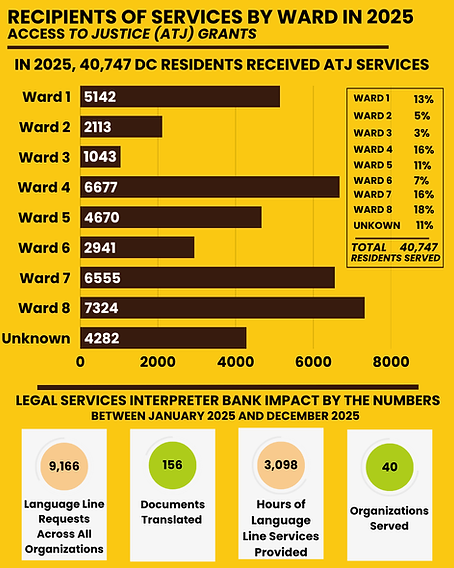
In FY25, the program served 40,747 DC residents across all eight wards, ensuring that civil legal aid is accessible where it is needed most. Services also include the Legal Services Interpreter bank that provides free legal interpretation to legal services providers in DC.
Civil Legal Counsel Projects Program
CLCPP supports a coordinated network of seven legal services organizations that provide representation and other legal assistances to tenants who are facing or at risk of eviction, loss of a housing subsidy, or unsafe housing conditions. Through this program, residents receive legal guidance, representation in court, and access to resources that help them remain safely housed.
In FY2025, CLCPP served 3,837 tenants, impacting 8,178 households across the District. By resolving cases efficiently—often before they reach trial—CLCPP not only stabilizes families, but also reduces strain on the court system and other public resources.

Real Testimonies of DC Residents Who Received Services
*All Names Have Been Changed to Protect the Identities of those Involved
Supporting Homeownership
Ms. Rivers, the surviving wife of Mr. Rivers, contacted the Future Planning and Probate Program through the DC Bar Pro Bono Center to receive help with her family home. She and her husband had owned a home together in D.C., where they were raising their three adopted children, when Mr. Rivers suddenly and unexpectedly passed away without a will. Amidst Ms. Rivers' grief and the profound changes facing her family, she was confronted with an even greater challenge: the mortgage company that held a loan on their home filed a petition to become the Personal Representative of Mr. River’s estate in order to sell the home and satisfy the mortgage. Although she was the surviving spouse, Ms. Rivers was unable to petition to become the Personal Representative herself, as she could not meet the bond requirements. The managing attorney for the Future Planning and Probate Program worked closely with Ms. Rivers and a trusted friend to file an objection to the mortgage company’s petition. They also helped the close family friend file a petition to be appointed as the Personal Representative, with Ms. Rivers' full collaboration. The court granted that petition, ensuring that Ms. Rivers and her friend, not the mortgage company, would control the probate process. This outcome helped Ms. River maintain the home and its equity, allowing her and her children to move forward with greater security and stability.
Enabling Access to Education
Mr. Johnson, the parent of a child with special needs attending a DC Public School, reached out to a legal services organization for help ahead of his child’s annual Individualized Education Program (IEP) meeting. His child had recently begun exhibiting concerning behaviors, drawing the attention of the entire IEP team. After previous conversations with the school left him feeling confused and mistrustful of their intentions, Mr. Johnson wanted to ensure that both his rights and those of his child were fully protected. The case was assigned to a staff attorney at a legal services organization. During the intake process, Mr. Johnson made clear his commitment to securing the proper supports for his child, though he was unsure what options were available. The attorney met with Mr. Johnson several times, reviewed the child’s records and relevant data, explained the legal framework under the Individuals with Disabilities Education Act, and helped Mr. Johnson define clear goals in advance of the IEP meeting. During the course of their preparation, a procedural error on the part of the school came to light. The staff attorney explained the nature of the error, advised Mr. Johnson on how to address it, and provided brief assistance by helping him draft a response. The error was resolved, and the collaborative relationship between Mr. Johnson and the school remained intact. With the guidance and support of the legal services organization, Mr. Johnson was empowered to advocate effectively for his child. The resulting IEP reflected the input and concerns of both the school and the family, and was designed to meet the child’s unique educational needs, ensuring access to a free appropriate public education.
Defending Against Fraud
Ms. Glanville suffered lead poisoning as a child, resulting in lifelong learning disabilities and cognitive challenges. She was approached by a company offering to purchase her future structured settlement payments. These payments were part of a legal agreement meant to compensate her for the injuries she sustained as a child. The transaction required court approval. Prior to the hearing, an employee of the company, Mr. M, called Ms. Glanville and coached her on how to answer questions during the proceedings. He instructed her not to ask any questions and did not disclose his involvement or coaching to the court. After the transaction was approved, the company mailed checks to Ms. Glanville. Following Mr. M’s instructions, she did not initially deposit the checks and instead kept the checks in her residence. Later, Mr. M drove her to a bank and directed her to deposit the checks. At his instruction, she put a large portion of the funds into a savings account and a smaller portion into a checking account. Mr. M then withdrew all of the funds from those accounts, and the accounts were eventually closed with no money having been returned to Ms. Glanville. When her structured settlement payments stopped arriving, she was surprised and confused because she did not fully understand the nature of the transaction. Ms. Glanville later obtained legal assistance to challenge both the undue influence surrounding the transaction and the loss of her funds. Her legal team also raised concerns about improper deductions and transfer fees, as well as the company's failure to provide accurate and complete disclosures in its court filings. These omissions may have violated court rules and applicable laws. The company has filed a motion to dismiss the case, which is now actively being litigated. Neither Mr. M nor the company that purchased the structured settlement rights appeared in court. A subpoena has been issued to the bank where the funds were deposited, and additional legal claims are under consideration to help Ms. Glanville recover what was taken from her.
Our Grantee Partners In the Community
The DC Bar Foundation is proud to partner with legal and supportive service providers across all eight Wards of the District. These organizations deliver essential services that promote safety, health, and stability in the community. As residents’ needs evolve, our partners continue to respond with dedication and commitment.


